 Zksync
 validity proofs and Ethereum scaling
Zksync scales Ethereum with cryptographic validity proofs that verify the execution of transactions on separate chains. Its public layer 2 (L2) rollup, Zksync Era, runs smart contracts and settles transaction batches on Ethereum. The broader protocol supports rollups and validiums that developers build with the modular ZK Stack framework, each with different data availability models. A rollup publishes the data needed to reconstruct its state on Ethereum, while a validium keeps that data elsewhere. Smart-contract compatibility, programmable accounts, and bridging extend the network's uses, with available features and access conditions varying by chain.
Updated:
The short version: A chain's data availability model determines how its state can be reconstructed and which dependencies affect access to funds.
Era applications and network-specific balances
Era supports smart-contract applications for token transfers, decentralized finance, and non-fungible tokens (NFTs). Smart contracts can implement exchanges, lending protocols, and other services using balances held on that chain, provided that the application has an Era deployment. An Ethereum-compatible wallet can connect to Era without moving its Ethereum balance into the network. Contracts and liquidity remain specific to their deployments, so a familiar application can have different assets or markets across networks.
Zksync Lite belonged to an earlier generation of the project and stopped producing blocks on May 4, 2026. Era continues as a separate network.
Proof generation and Ethereum settlement
A sequencer orders transactions and executes them in the chain's virtual machine, updating balances and contract storage. The prover then creates cryptographic evidence that the batch followed the protocol's execution rules. Ethereum smart contracts verify the validity proofs that attest to a chain's state transitions. Verifying this compact evidence requires less work than repeating every application operation on Ethereum, while batching spreads settlement costs across the transactions that a batch contains.
A validity proof can confirm correct execution of an application contract that still contains a vulnerability that exposes its users.
A sequencer's quick confirmation precedes Ethereum settlement, so a wallet can show successful L2 execution while its batch awaits proving or finalization. Settlement also requires batch execution on Ethereum and finality of the underlying Ethereum blocks. A transaction hash alone does not confirm execution, and even a successful L2 receipt does not establish that an Ethereum withdrawal has completed.
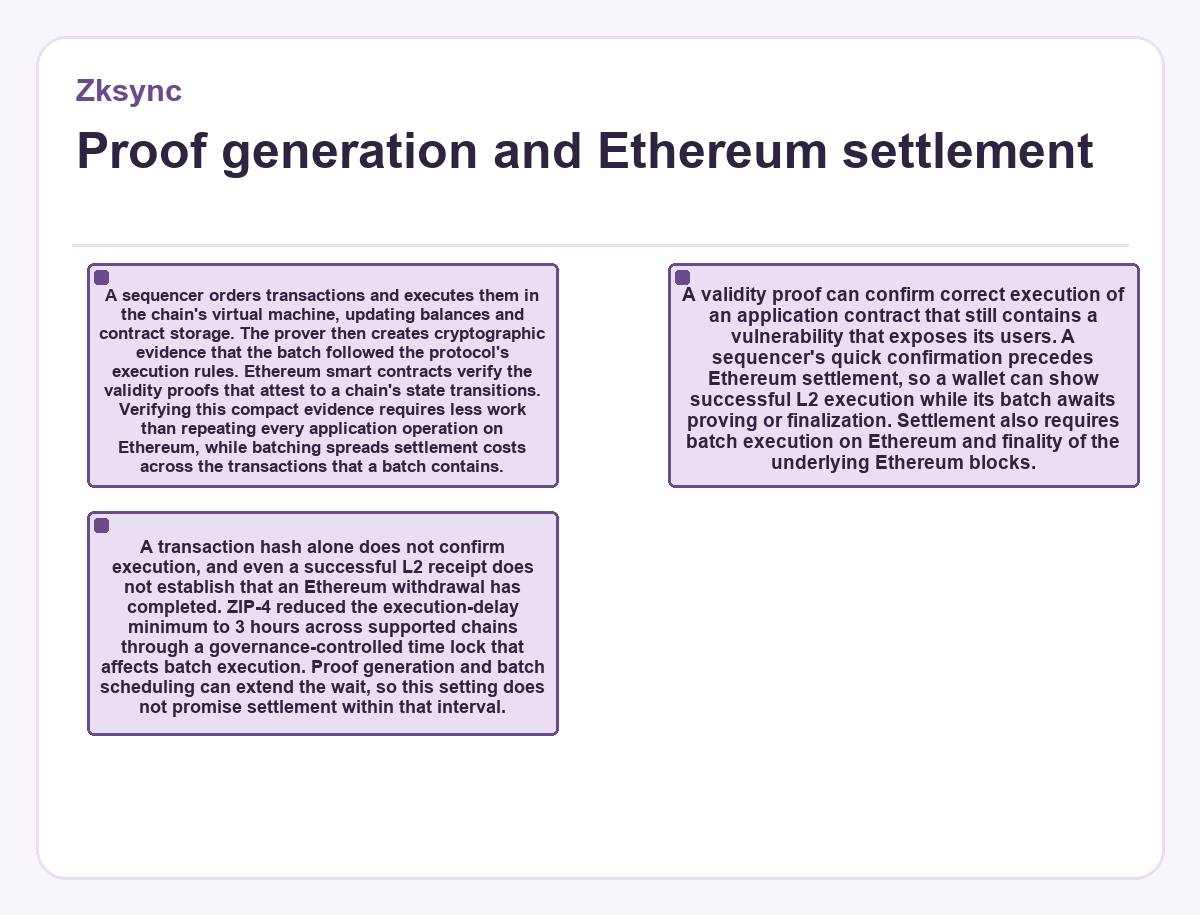
ZIP-4 reduced the execution-delay minimum to 3 hours across supported chains through a governance-controlled time lock that affects batch execution. Proof generation and batch scheduling can extend the wait, so this setting does not promise settlement within that interval.
Rollup data and validium access conditions
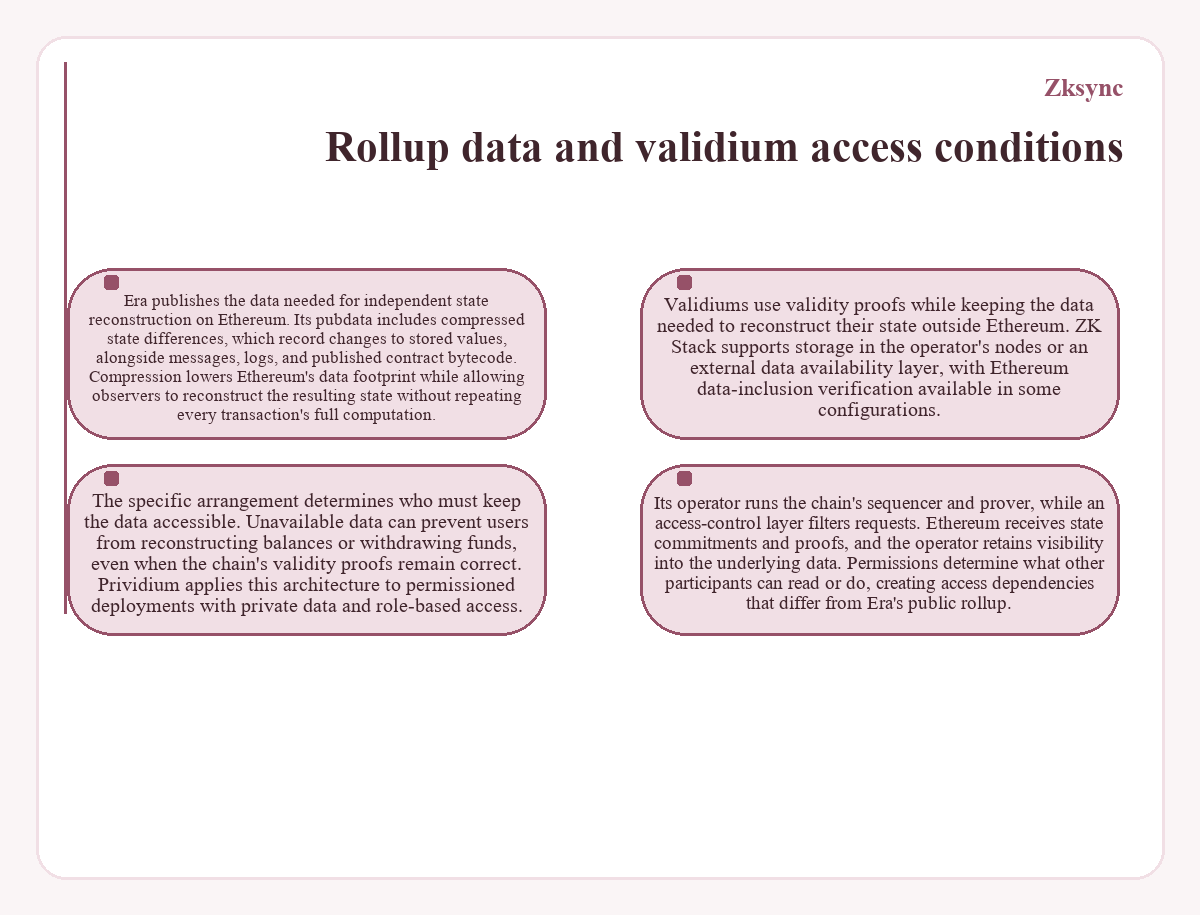
Era publishes the data needed for independent state reconstruction on Ethereum. Its pubdata includes compressed state differences, which record changes to stored values, alongside messages, logs, and published contract bytecode. Compression lowers Ethereum's data footprint while allowing observers to reconstruct the resulting state without repeating every transaction's full computation.
Validiums use validity proofs while keeping the data needed to reconstruct their state outside Ethereum. ZK Stack supports storage in the operator's nodes or an external data availability layer, with Ethereum data-inclusion verification available in some configurations. The specific arrangement determines who must keep the data accessible.
Unavailable data can prevent users from reconstructing balances or withdrawing funds, even when the chain's validity proofs remain correct.
Prividium applies this architecture to permissioned deployments with private data and role-based access. Its operator runs the chain's sequencer and prover, while an access-control layer filters requests. Ethereum receives state commitments and proofs, and the operator retains visibility into the underlying data. Permissions determine what other participants can read or do, creating access dependencies that differ from Era's public rollup.
Programmable accounts and conditional fee sponsorship
Era's native account abstraction lets smart accounts authorize transactions using contract logic that can enforce multiple signatures or spending limits. The underlying protocol fee uses ETH, and paymasters can sponsor it or accept payment in supported ERC-20 tokens. The account implementation determines its authorization features; the transaction interface must include appropriate paymaster parameters when requesting sponsorship. Eligibility rules and accepted tokens vary by paymaster. Its involvement also adds computation, so sponsorship changes who pays without eliminating the underlying execution cost.
Asset entry routes and transaction costs
Assets can enter Era through the Ethereum bridge or another transfer service that supports the network. Direct exchange withdrawals provide another path when the exchange enables withdrawals on Era for the selected asset. The default ERC-20 bridge locks backing tokens on Ethereum and creates their corresponding representation on L2. A bridge's token support determines whether it can handle the intended asset, while balances on different chains remain separate even when a wallet displays them under one address.
Era's transaction charges reflect computation and the data that the operation contributes to publication. Ethereum data costs influence rollup fees, while different contract operations consume different execution resources. Storage modifications and contract-code publication can change the amount of data that an operation contributes. Bridges that involve Ethereum need base-layer transactions, whose gas charges add to the cost of entering or leaving Era. Application charges, such as exchange trading fees, sit outside the network gas fee.
A default-bridge withdrawal creates a message to Ethereum's base layer (L1). Once its batch satisfies settlement requirements, the Ethereum bridge needs a finalization call to release backing assets to the withdrawal recipient, incurring an L1 gas charge. Other transfer services can have different delivery arrangements and charges.
ZK Stack execution, interoperability, and governance
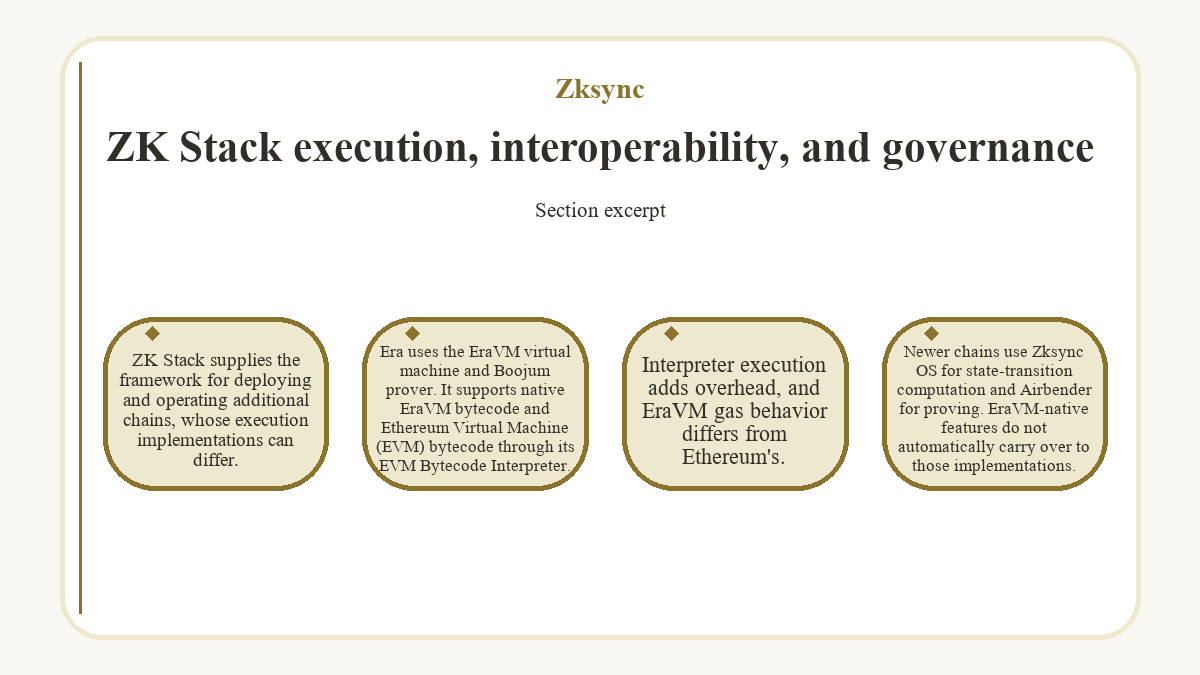
ZK Stack supplies the framework for deploying and operating additional chains, whose execution implementations can differ. Era uses the EraVM virtual machine and Boojum prover. It supports native EraVM bytecode and Ethereum Virtual Machine (EVM) bytecode through its EVM Bytecode Interpreter. Interpreter execution adds overhead, and EraVM gas behavior differs from Ethereum's. Newer chains use Zksync OS for state-transition computation and Airbender for proving. EraVM-native features do not automatically carry over to those implementations.
The Elastic Network connects ZK Stack chains through shared protocol infrastructure, with Zksync Connect providing cross-chain messaging. Zksync Connect's cross-chain asset transfers and transaction bundles are not yet live on mainnet or testnet; both await a future protocol upgrade. Gateway previously aggregated proofs between chains and Ethereum; it is deprecated, and chains that used it for settlement have migrated to direct Ethereum settlement.
Protocol governance uses delegated ZK voting power, with additional roles for the Security Council and Guardians in its review and emergency procedures. A chain's proof system and its governance controls address different dependencies: proofs check execution, while governance can change protocol rules.
- If public state reconstruction is required, choose a rollup that publishes the necessary data on Ethereum.
- For a validium, identify who maintains data access and whether the chain verifies data inclusion.
- Match the application deployment and supported token to the intended destination chain.
- Count on sponsored fees only when the paymaster accepts the transaction under its eligibility rules.
Ethereum mainnet remains an alternative when the required application or asset exists only there. Era shifts execution to L2 and shares batch costs when an appropriate deployment exists, adding its sequencer and bridge-settlement dependencies.
Zksync: frequently asked questions
Which chain ID identifies Era mainnet?
Era mainnet uses chain ID 324, while the Era Sepolia testnet uses chain ID 300. Both environments identify ETH as their currency, so the currency symbol alone does not distinguish them. Wallets and applications can read the connected network's ID through the eth_chainId method. Mainnet balances and transactions belong to a different environment from testnet balances and transactions.
Does a zero-knowledge proof hide Era transaction history?
A validity proof does not make Era's public transaction history confidential. The proof establishes that execution followed the protocol's rules, while public rollup data supports state reconstruction. Explorers can display transactions, addresses, and contract activity. Privacy requires additional design choices; the word "zero-knowledge" in the scaling technology does not imply that ordinary transfers conceal their participants or amounts.
Can rebasing tokens use the default ERC-20 bridge?
The default ERC-20 bridge supports standard ERC-20 functionality and does not support rebasing tokens or other custom token behavior. Compatibility requires more than an ERC-20 interface or a familiar symbol. Such assets need an appropriately designed custom bridge or another supported representation. This restriction concerns the default bridge's implementation and does not rule out a custom bridge that handles those mechanics.
Is holding ZK enough to activate governance voting power?
ZK voting power requires delegation before an address can use it in governance. A holder can delegate to their own address or another delegate, and delegation does not transfer ownership of the tokens. The receiving address gains the associated voting power. Tokens that remain in a centralized exchange wallet do not give its customers direct control over that wallet's delegation.
How can an Era smart account support recovery after a lost key?
An Era smart account can implement recovery through the authorization rules in its contract. Native account abstraction enables programmable validation, including wallet designs that support account recovery. The particular wallet determines which recovery mechanism exists and who can invoke it. An ordinary account does not acquire recovery features merely by connecting to Era, and the protocol does not supply every wallet with a universal recovery procedure.